

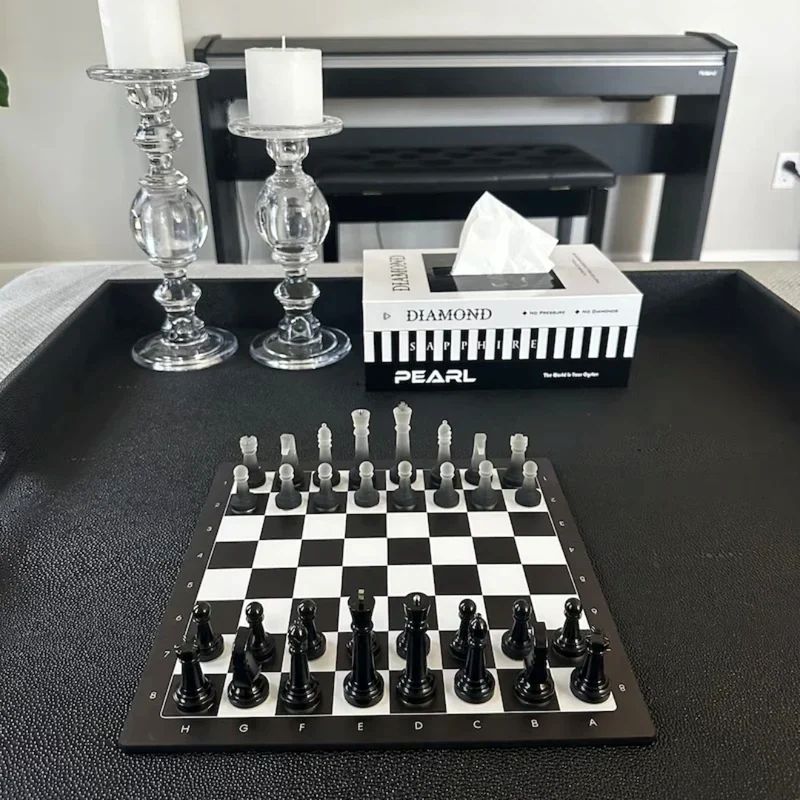
Every chess match is an exercise in logical thinking, where players enter a realm of careful analysis to make precise strategic decisions. To begin the journey of mastering this intellectual sport, the very first thing a chess player must understand is the exact number of each type of chess pieces and the unique way each one moves across the chessboard. A thorough understanding of the battlefield not only helps you take command of the rules with confidence, but also opens the door to deeper insights into the art of strategic deployment behind every move.
Discover Maztermind’s premium chess masterpieces
When stepping into the world of chess, accompanying yourself with an exquisite chess set not only brings excitement to every move but also reflects the lifestyle and refined taste of its owner. At Maztermind, we dress familiar chess matches in a new identity through contemporary design language and master-level craftsmanship created by skilled Vietnamese artisans.
Our premium chess collection represents the perfect intersection between strategic thinking and the art of interior aesthetics. By combining carefully selected materials such as warm Walnut wood, supple leather, and innovative materials including solid-cast Resin and Concrete with a satisfyingly substantial weight, Maztermind provides chess enthusiasts with the perfect battlefield upon which they can fully appreciate the beauty and significance of every character in the world of chess.

Premium materials crafted into a masterpiece of modern design
>>> See more: Experience the exceptional craftsmanship of our Luxury Chess Set collection
How many pieces are there in a standard Chess Set?
For those who are just beginning to explore this intellectual sport, the most fundamental question is always how many chess pieces are on the board. According to international standards, a complete chess set consists of a total of 32 pieces, providing a clear answer to the common question of how many pieces in chess.
At the beginning of a match, each player commands a force of 16 carefully organized pieces. This army is arranged into two distinct strategic formations: a frontline consisting of 8 identical pieces that serve as a protective shield, and a backline made up of 8 strategic pieces with different names and appearances. This distribution creates a perfectly balanced battlefield where victory is determined not by numbers, but by the player's ability to utilize the unique role of every piece effectively. For beginners researching how many pieces in a chess set, understanding this balanced structure is the first step toward mastering the game.

The perfect balance of thirty-two international standard pieces
>>> See more: Discover the professional standard of the Tournament Chess Set
Names and movement rules of every Chess Piece
One of the first lessons for new players is learning the name of chess characters and understanding how each piece contributes to the overall strategy. The fascination of chess lies in the fact that every piece possesses its own distinctive appearance and follows a unique movement and capturing pattern. When these movement rules are combined, players can create countless traps, combinations, and attacking strategies.
Pawn – The courageous warriors of the frontline
The most numerous pieces on the chessboard are the Pawns, with eight assigned to each side. On their very first move from the starting position, a Pawn has the privilege of advancing either one or two squares forward. However, after that initial move, it may advance only one square at a time.
Although the Pawn is the least valuable piece and can never move backward, it possesses a remarkable power known as Promotion. If a determined Pawn survives every obstacle and reaches the final rank on the opponent’s side of the board, it can immediately transform into any stronger piece, including a Queen, Rook, Bishop, or Knight.


The brave Pawns standing firm on the front line
Rook – The fortress guarding the four corners
Each player possesses two Rooks positioned at the outermost corners of the back rank. The Rook symbolizes steadfast defensive strength and direct offensive power.
On the chessboard, a Rook may move horizontally or vertically across as many squares as desired, provided its path is not blocked by another piece. With its straightforward movement and extensive range, the Rook often becomes a key force in strategic encirclements and endgame finishing attacks.


Rooks positioned securely at the corners for solid defense
Knight – The unexpectedly agile cavalry
Standing beside the Rooks are the two Knights, symbols of elite cavalry forces. The Knight possesses the most distinctive movement pattern on the board, traveling in an L-shape by moving two squares in one direction and then one square perpendicular to it.
The Knight’s most unique ability is its power to jump over all other pieces, regardless of whether they are allies or enemies. This extraordinary capability transforms the Knight into a highly effective secret weapon in crowded positions, capable of creating unexpected tactical traps that catch opponents off guard.


The agile Knights moving in a unique L-shaped pattern
Bishop – The master of diagonal strategy
Next to the Knights stand the two Bishops, the closest guardians of the royal family. Each player controls one Bishop that operates on light-colored squares and another that remains on dark-colored squares throughout the game.
A Bishop may move diagonally across any number of squares, provided it remains on the same color as its starting square. Together, the pair of Bishops creates a strategic pincer formation capable of controlling vast areas of the board and supporting powerful long-range attacks.


Bishops dominating the long diagonals across the board
Queen – The symbol of supreme power
The queen chess piece is the most powerful figure on the chessboard. Each kingdom possesses only one Queen, positioned at the center of the back rank on a square matching her own color.
The Queen’s intimidating strength comes from combining the movement abilities of both the Rook and the Bishop. She may move vertically, horizontally, or diagonally across any number of squares. Having a versatile queen chess piece on the board is like commanding an exceptional field general capable of transforming the course of a battle in a single move.


The powerful Queen ruling the center of the board
King – The heart and soul of the match
The king chess piece is the final and most important piece in the game. Despite occupying the highest throne, the King moves with caution, advancing only one square in any direction around itself.
The king chess piece is not the strongest attacking piece, but it is the ultimate objective that the entire army must protect. A match immediately ends when one side is placed in Checkmate, meaning the King is under attack and has no legal escape. The safety of the King serves as the guiding principle behind every defensive and counterattacking strategy on the chessboard.


Protect the King, the ultimate soul of your strategy
Understanding exactly how many chess pieces are in play, along with the name of chess characters and the movement rules of every piece, provides the strongest possible foundation for confidently taking control of the game. For players still wondering how many pieces on chess boards are required for a standard game, the answer remains a perfectly balanced set of 32 pieces divided equally between two opponents.
When the unmatched power of the Queen, the resilience of the Pawn, and the strategic vision of the supporting pieces are brought together in harmony, a chess match truly becomes a complete masterpiece of intellectual artistry.
To bring those strategic ideas to life in the most fulfilling way possible, experiencing the game on a tournament-worthy chessboard that also embodies sophistication is equally important. This is precisely why Maztermind chess sets were created - a collection where every piece is meticulously crafted to deliver a substantial and precise feel in hand, allowing you to sense the true weight of every decision.
Place these exquisite creations upon the battlefield and begin writing a strategic story that bears your own unmistakable signature.

Leave a comment
This site is protected by hCaptcha and the hCaptcha Privacy Policy and Terms of Service apply.